
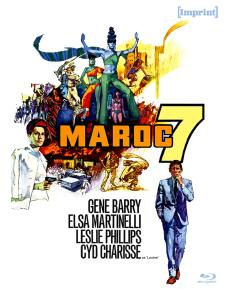
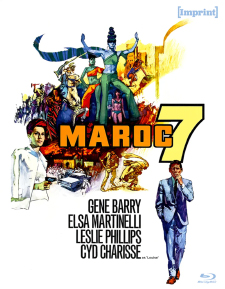
Maroc 7 (Blu-ray Review)
Director
Gerry O’HaraRelease Date(s)
1967 (March 25, 2026)Studio(s)
Cyclone Films/Rank Film Distributors (Imprint Films/Via Vision Entertainment)- Film/Program Grade: B
- Video Grade: A
- Audio Grade: A-
- Extras Grade: B+

Review
[Editor’s Note: This is a Region-Free Australian Blu-ray import.]
Better than one might have expected, Maroc 7 (1967) is a British-made suspense thriller produced in the wake of the 007 craze. Something like a fusing of elements from the musical Funny Face (1957), Mario Bava’s Blood and Black Lace (1963) and the James Bond films, Maroc 7’s plot and characters aren’t bad, but where the film really surprises is in its unexpectedly mesmerizing Panavision cinematography.
Gene Barry stars as safecracker Simon Grant, who breaks into the home of fashion magazine editor Louise Henderson (Cyd Charisse), stealing her jewels. In fact, he’s an undercover man—though just for whom is never revealed—trying to infiltrate Henderson’s criminal network, she using modeling shoots all over Europe, North Africa, and the Middle East to smuggle precious stones and priceless artifacts, aided by model Claudia (Elsa Martinelli), Professor Bannen (Eric Barker), and photographer Raymond Lowe (Leslie Phillips, who also co-produced the film). Grant uses Henderson’s stolen jewels as an “in” to her latest plot, to steal a valuable medallion during a photo shoot in Morocco. In Morocco, Grant is met by Inspector Barrada (Denholm Elliott) and Michelle Craig (Alexandra Stewart), she assigned to assist Grant.
When director Stanley Donen made Funny Face, about a fashion shoot in Paris, he hired acclaimed photographer Richard Avedon (Harper’s Bazar, Vogue) as a consultant, Avedon providing photographs used in the film and conferring with Donen about the visual style of that film, especially the photo sessions between the characters played by Fred Astaire (modeled after Avedon himself) and his new model, played by Audrey Hepburn. Maroc 7 seems to go one better, with entire scenes playing out as if they were shot by an Avedon-type photographer. Where Funny Face’s unique look is somewhat undermined by process shots (freeze-frames, multiple exposures, etc.), at times Maroc 7 looks like a fashion spread come to cinematic life. The lighting, use of lenses, the fashions the models wear, their hairstyles—everything looks startling vibrant.
It’s difficult to say who precisely is responsible for this look. Director Gerry O’Hara? Kenneth Talbot (Born Free), the credited director of photography?
Part of the pleasure of watching Maroc 7 is due to its excellent video transfer, but even in scenes without the models the film is impressively razor-sharp throughout, at times almost like a Technirama or 65mm negative. It also doesn’t hurt that all the women in Maroc 7 are gorgeous. Cyd Charisse was in her mid-40s but still a knockout, while Elsa Martinelli (Hatari!), Tracey Reed (Dr. Strangelove), and others, probably professional models, are very sexy and visually striking, as is Alexandra Stewart, a French-Canadian often appearing in French films of the period, who is gorgeous as well—and they’re all beautifully photographed. In one sense, this doesn’t make Maroc 7 a better film, but even when the narrative becomes predictable, in almost every scene there’s a beautiful woman beautifully photographed to look at.
Fascinating, too, is how Maroc 7 captures Swinging London fashions far better and more accurately than most films of this type (though American, the gaudy Matt Helm movies with Dean Martin come to mind). The story isn’t bad, and Gene Barry is good at anchoring the plot; he’s pleasant and appealing without camping it up. The ruthlessness of the Cyd Charisse character is also refreshing, while Leslie Phillips, usually typecast as lascivious upper-class types, here plays a brutal killer. Angela Douglas, remembered best as the wide-eyed ingenue in several Carry On comedies, as Henderson’s dutiful assistant likewise ends up with a very atypical fate in this story. The picturesque Moroccan locations also help.
So, while its story is nothing special, the slickness of the production, the good cast, and especially the cinematography more than compensate for the occasional dull or predictable patches.
Imprint’s Region-Free Blu-ray presents this Panavision and (prints by) Technicolor film in its original 2.35:1 aspect ratio, in 1080p via a video transfer provided by ITV, not stated but perhaps a 4K scan of the original camera negative. The transfer is superb; I don’t think I’ve seen a Blu-ray of a mid-1960s Panavision title look any better than this. The LPCM 2.0 mono audio is good for what it is, and optional English subtitles are provided.
The above average supplements consist of a new audio commentary track by writers Kim Newman and Barry Forshaw; Beyond Maroc 7, a new interview with producer John Gale; a trailer and image gallery, and a music promo featuring The Shadows, who released a popular instrumental single adapted from the film.
As a movie, Maroc 7 is not bad, but the eye-candy it generates makes this a very worthwhile viewing experience.
- Stuart Galbraith IV