
Krakatit (4K UHD Review)

Director
Otakar VávraRelease Date(s)
1948 (May 12, 2026)Studio(s)
Ceskoslovenská Filmová Spolecnost (Deaf Crocodile Films)- Film/Program Grade: B
- Video Grade: A-
- Audio Grade: B+
- Extras Grade: B

Review
On June 15, 2017, Part 8 (aka “Gotta Light?”) of David Lynch and Mark Frost’s Twin Peaks: The Return was unleashed on unsuspecting viewers, opening with a stark black-and-white image of the 1945 atomic test in New Mexico, blowing people’s minds in the process and leading to debates that continue to this very day. Six years later, Christopher Nolan’s Oppenheimer opened, building on the real Robert Oppenheimer’s questionable translation from the Bhagavad Gita to explore the effect on the human psyche of being responsible for such a destructive force. Granted, Oppenheimer’s quotation that “I am become Death, the destroyer of worlds” was in the context of Vishnu persuading Prince Arjuna to do his duty in killing his kinsmen because time comes for all men anyway—and in this case, Oppenheimer was putting himself in the shoes of Arjuna, not Vishnu. Still, there’s no way that playing such a role wouldn’t weigh heavily on a person’s conscience, making it an idea that’s ripe for exploration.
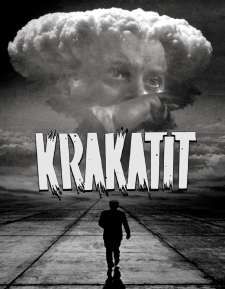
So... what if I was to tell you that 69 years before “Gotta Light?” and 75 years before Oppenheimer, an equally stark black-and white film explored how being the person responsible for an unparalleled destructive force can have no less devastating effects on the one who created it—and that it did so while utilizing surrealistic imagery that’s every bit as mind-blowing as anything that Lynch ever imagined? That film is Czechoslovakian director Otakar Vávra’s 1948 effort Krakatit, an unforgettable visualization of the interior dream states of a man whose mind is cracking under the strain of his dubious accomplishment.
Krakatit is based on the 1922 novel by Czech author, playwright, and journalist Karel Čapek, so it actually predated the nuclear age. (Čapek was inspired by the Bolevec Disaster in 1927, where a massive explosion ripped through the Škoda Works munitions plant.) And to be fair, Otakar and Jaroslav Vávra’s script doesn’t exactly reorient Čapek’s story to reflect the splitting of the atom, leaving Krakatit as a somewhat mysterious explosive force that can’t be explained or controlled (although as director, Otakar couldn’t resist the temptation to have one of the final detonations appear in the shape of a mushroom cloud). They did, however, add a framing device that reinforced the dreamlike structure of Čapek’s book by making everything that occurs in the story appear as the dreams of a badly injured, unidentified man—and to make sure that no one misses that point, Krakatit opens with a title card that reads:
“The story takes place in the midst of a feverish dream.”
The man in question is Prokop (Karel Höger), and while the dream states that what we see through his closed eyes may or may not be entirely real, he’s suffering from bacterial meningitis, so the life-threatening fevers are all too corporeal. Prokop has invented a powerful explosive that he has dubbed “Krakatit” after the astonishing explosive force of the Krakatoa volcano in 1883. Needless to say, the secrets of his invention are sought by various international forces, leading him to move from dream state to dream state, and even from time period to time period, with no clear chronology or spatial continuity for what’s happening to him, and no one that he can trust save for a kindly old mailman (Jaroslav Průcha) who Prokop encounters repeatedly. Everyone else who seems to be helping him may have ulterior motives of their own, and with the fate of the world at stake, Prokop’s sanity becomes a fever dream of its own. Krakatit also stars Florence Marly, Eduard Linkers, Jiří Plachý, Nataša Tanská, František Smolík, and Miroslav Homola.
Aside from the framing device, reality and dreams blend all throughout Krakatit in a way that leaves no clear dividing line between the two. Since Prokop is constantly being manipulated in an attempt to make him reveal his secrets to the outside world, he can never be sure where he stands, even while in an active dream state. And since we see what he sees, we’re never sure what may or may not be real. Vávra employed a witch’s brew of cinematic techniques in order to keep viewers disoriented, including slow motion, multiple exposures, forced perspective, matte paintings, and much more. Some of that bears the obvious influence of German expressionism, but Vávra didn’t limit himself to one genre or style. Instead, like Lynch, he let his own eye be his guide.
Now, as a product of the postwar nationalized film industry in Czechoslovakia, Krakatit does bear some of the influence of the ruling Communist party. It couldn’t possibly be any farther removed from social realism, but Prokop does encounter a group that rallies around a charismatic neofascist figure who wants to protect them from the riff-raff (although another character points out that it’s just a charade to keep the people supporting the wars that allows the military-industrial complex to thrive). And there’s a definite emphasis on the joys of work, first from the kindly Dr. Tomeš (Smolík) and later from the ubiquitous mailman. In the novel, the mailman ultimately becomes a literal figure for God, redirecting Prokop’s creative energies to invent something beneficial for mankind instead. Yet while the film is more ambiguous about the mailman’s identity, his message is even clearer:
“What one meets comes from inside... It was your pride. It was in you. Even your invention... And why? What good is an explosion? Find something that would drive another thing to make the work of people easier. Do you understand? Invent something that would help people and not kill people. Then, it would be a truly great invention.”
Prokop does finally understand, and it’s only at that moment that his fever breaks, his eyes open, and he can see everything clearly. Yet there’s a reason why other directors like David Lynch and Christopher Nolan have continued to be able to exploit nuclear fears so effectively: 78 years after Prokop, we still haven’t woken up alongside him.
Cinematographer Václav Hanuš shot Krakatit on 35mm film using spherical lenses, framed at 1.37:1 for its theatrical release. This version is the 2016 restoration done by the Hungarian Filmlab in Budapest using film elements preserved at the National Film Archive in Prague. It’s primarily based on a 4K scan of the original nitrate negative, although a dupe positive was used to replace missing sections. While the 2016 remastering was graded for SDR only, this release has added HDR grades in Dolby Vision and HDR10. But they don’t stray far beyond the limitations of the source, resisting the temptation to exaggerate the highlights in a way that could obscure inner detail. The abundant optical work has minor defects like scratches, speckling, and dirt, but that’s all been left alone in order to reflect how the film would have appeared to audiences in 1948. (There are also a few changeover marks visible, presumably in sections taken from the dupe positive). The frequent optical work and the use of diffusion by Hanuš means that it’s not always the sharpest image, but it can indeed be quite sharp in the native, unfiltered negative material. Overall, it’s a pleasing 4K presentation.
Audio is offered in Czech 2.0 mono DTS-HD Master Audio, with removable English subtitles. While the audio quality on all the various available elements was assayed, the duplication positive was used as the primary source here. There’s still just a touch of excessive sibilance in some of the dialogue, and perhaps a little distortion in some of the loudest musical peaks, but the sound is otherwise clean, clear, and free of any major artifacts. Background noise and hiss are minimal. Jiří Srnka’s potent score sounds quite good despite any limitations in the source, and it’s one of the key elements that make Krakatit work as well as it does.
The Deaf Crocodile Deluxe Limited Edition 4K Ultra HD release of Krakatit is a two-disc set that includes a Blu-ray with a 1080p copy of the film. It also includes a 60-page booklet featuring essays by Walter Chaw and Jonathan Owen. Everything comes housed in a rigid slipcase with a J-card slipcover, both of which feature artwork by Richard Cox. It’s limited to 1,150 units, although Deaf Crocodile is releasing a standard version as well that omits the booklet and the slipcase. The following extras are included on both discs, all of them in HD:
- Commentary by Irena Kovarova and Peter Hames
- Krakatit: Moral Vertigo in the Nuclear Age (18:46)
- Interview with Tereza Frodlová (48:37)
The commentary reteams Irena Kovarova, film programmer and founder of Comeback Company, with critic Peter Hames, author of The Czechoslovak New Wave. They provide an overview of the career of Otakar Vávra and discuss the influences that he brought to bear on Krakatit, including whether or not there’s a noir influence at play. They also cover Karel Čapek’s novel, the cast, and examine the themes of the story. But in many ways, their most interesting discussion is regarding how the film fit into the postwar period in Czechoslovakia, including the effects of the communist takeover and the nationalization of the Czech film industry. As a result, their commentary offers much more of interest than just a look at Krakatit itself.
Krakatit: Moral Vertigo in the Nuclear Age is a visual essay by film critic and lecturer Clayton Dillard, who focuses more on the context of how Krakatit fits into postwar nuclear anxiety. He says that the film’s fever dream structure merges form and content into something that reflects the onset of Cold War division. Actually, he describes this kind of dream state cinema as more of a seismograph than just a reflection, recording the tremors felt by those who experienced this kind of moral vertigo—it’s a visualization of the collective sensations of those affected by the seismic upheavals of the era. The disorienting visuals in the film are a result of the disorientation felt by those whose world had changed.
Finally, there’s an interview with Tereza Frodlová, archivist and restoration specialist at the National Film Archive in Prague, which was conducted online by Deaf Crocodile’s Dennis Bartok. She gives her own personal background before moving on to her restoration work and the challenges of remastering Krakatit. She acknowledges the issues with handling films where the director and cinematographer have both passed away, which means only being able to rely on whatever reference material that you can find. She talks about the literal dangers involved with handling nitrate film elements. They also have an interesting discussion regarding leaving defects like changeover marks alone in the remastering process (Bartok mentions how Deaf Crocodile’s Craig Rogers feels strongly that those should be left alone).
Since Krakatit is making its North American debut here, there aren’t any missing extras from previous domestic releases, although there are a few bits and pieces from overseas discs that haven’t been included, mostly from the Czech Republic: an introduction; various brief interviews, galleries, and filmographies; and a collection of unrelated short films and a restoration demo. (The 2018 Region B Blu-ray from Ostalgica in Germany also included the East German version of Krakatit and a 2014 audiobook.) But needless to say, Deaf Crocodile’s 4K Ultra HD release easily trumps all of them, and it’s not even close. If you’re already familiar with the disorienting world of Krakatit, this is a must-buy, and if not, it’s inarguably the best way to learn that there are more things in Heaven and Earth than are dreamt of in your philosophy. Highly recommended.
-Stephen Bjork
(You can follow Stephen on social media at these links: Twitter, Facebook, BlueSky, and Letterboxd).