
Frankenstein’s Bloody Terror (Blu-ray 3D Review)

Director
Enrique López EguiluzRelease Date(s)
1968 (August 26, 2025)Studio(s)
Maxper Producciones Cinematográficas/Independent-International Pictures (Kino Cult)- Film/Program Grade: C
- Video Grade: C+
- Audio Grade: B+
- Extras Grade: A-

Review
La Marca del Hombre Lobo (The Mark of the Wolfman) was released in 1968, making its way throughout Europe and the U.K. in 1969 and 1970 to remarkable business at the box office. During that time, it was known by a number of different titles, including Hell’s Creatures, Die Vampire des Dr. Dracula (The Vampires of Dr. Dracula), and Le notti di Satana (The Nights of Satan), later changing to other monikers such as Der Wolfsmensch (The Wolf-Man) and Hexen des Grauens (The Witches of Terror). However, its most infamous title came in 1971 when it was released by Sam Sherman’s Independent-International Pictures, playing in U.S. theaters and drive-ins as Frankenstein’s Bloody Terror, despite the fact that Frankenstein nor his monster appear in the film. It nevertheless put its lead actor, Paul Naschy (Jacinto Molina Álvarez), on the monster movie map, where he would make a number of other werewolf movies.
As the opening prologue makes clear, the Frankenstein family has been cursed with lycanthropy, subsequently becoming the Wolfsteins (which was done to satisfy a “Frankenstein” double bill). Upon the accidental resurrection of Imre Wolfstein (Antonio Giménez Escribano), Count Waldemar Daninsky (Naschy) is attacked while hunting him down, becoming a wolfman himself and escaping his castle at night to kill any unlucky local villagers. Not wanting to hurt anyone, he seeks the help of Dr. Janos Mikhelov (Julián Ugarte) and his assistant Wandesa (Aurora de Alba). What he doesn’t know is that they are in fact vampires, intent on making victims out of Waldemar’s closest “friends” (most of the romantic subplot was dropped from this version), Janice (Dyanik Zurakowska) and Rudolph (Manuel Manzaneque). However, even chained at the wrists and locked behind bars in the castle’s dungeon won’t stop Waldemar’s werewolf rampages.
Frankenstein’s Bloody Terror is not the ideal version of this film when it comes to story, especially since the first reel was hacked out of it completely, leaving out the setups for character motivations and a semi-love triangle, as well as other minor edits throughout (and a different score). That said, it’s still an entertaining romp in its own right, especially in 3D. It’s clear how and why Paul Naschy became such an international star as he’s absolutely magnetic in and out of the werewolf make-up. Much of the film owes its existence to his having seen Frankenstein Meets the Wolf Man when he was a child, and later in life having to convince other filmmakers to make a werewolf movie, with him as the star. It turned out to be Spain’s first werewolf movie, as well as the first in the highly successful Hombre Lobo series that would span twelve films (really eleven since the existence of one of those films is up for debate). If you’re familiar with Paul Naschy and the horror output of Independent-International, you should know what to expect here. This isn’t Shakespeare, nor does it try to be. It’s simply a fun, old-fashioned monster movie with lovely cinematography, some nice performances, and quality stereoscopic images.
Cinematographer Emilio Foriscot shot La Marca del Hombre Lobo on 65mm Eastman film using the Hi-Fi Stereo 70 3D system, made up of converted M.C.S. 70 Studio cameras. The results were finished photochemically with an aspect ratio of 2.20:1 for 70mm projection and 2.35:1 for 35mm projection. The film played in the U.S. as Frankenstein’s Bloody Monster in 1971 in its flat, non-3D presentation on double and triple bills with the likes of Sting of Death, Gallery of Horror, Dracula Has Risen from the Grave, and Horror of Dracula, but more prominently, Independent-International’s Dracula vs. Frankenstein (among others). On January 19, 1972, it finally premiered in 3D at the Egyptian Theatre in Hollywood where it was received poorly due to low quality projection using acrylic lenses. It wasn’t seen again until 2017 when Garagehouse Pictures and Exhumed Films re-premiered it in 3D at New York’s Quad Cinema to much fanfare.
Unfortunately, the original 3D presentation was rushed for its 1972 Egyptian Theatre premiere. A 35mm reduction dupe negative was made from a 70mm positive print by Linwood Dunn of Film Effects of Hollywood. Several generations away from the original camera negative, this surviving internegative suffers from poor quality opticals and major Ektachrome rot, meaning that the element is deteriorated and detail is sadly gone forever and cannot be retrieved. The superior vault materials, consisting of the original 65mm camera negative AND it’s magnetic 4-track stereo soundtrack, are foolishly being held hostage by an unnamed film hoarder who saved it from a defunct film laboratory. They refuse to allow anyone access to it outside of Europe, and there are currently and lamentably no film scanners in Europe equipped to scan 65mm camera elements.
As such, a 4K scan of the badly-deteriorated 35mm internegative is the only source that the experts at 3-D Film Archive had to work with. Extensive restoration has been performed to minimize as many issues as possible, but the inherent softness and loss of detail is unavoidable. Dave Northrop of FilmMedia spent a large amount of time slavishly attempting to re-time and restore the film. The results are better than expected based upon all of that knowledge beforehand (you’re more than urged to watch Tim Lucas’ featurette about the film prior to seeing it in order to better understand what you’re getting yourself into).
The polarized 3D presentation is quite wonderful. The opening prologue titles are flat, but the film is otherwise mostly made up of wide and medium shots, meaning that the filmmakers were mostly going for depth, although there are occasional moments when Waldemar in wolf form lunges at the screen for effect. The flat, non-3D presentation, which has been sourced from the left eye of the internegative, is pretty rough and definitely not the preferred viewing option (though one must take into the account the amount of effort put into making it at least watchable). Subkultur Entertainment released the original version of the film on Blu-ray in Germany, and one would think that a flat version of the U.S. cut could be achieved by conforming to that superior footage, but it’s more likely that time, money, and distribution rights prevented something like that from happening. It’s not a total loss though since there are moments that offer some nice color and detail where the original element is less deteriorated, but they’re harder to come by. The anaglyphic presentation, achieved using 3-D Film Archive’s exclusive Adaptive Multi-Band Anaglyphic Encoding process, actually manages to hide many of these flaws. It’s not exactly superior to the standard polarized 3D presentation, but it’s definitely worth checking out for contrast and comparison. Some may even prefer it, and as always, it’s a nice alternative to have for those without Blu-ray 3D capabilities.
On a grading scale, the polarized 3D presentation would warrant a B+, the anaglyphic 3D would receive a B, and the flat presentation would receive a C, possibly lower. In this particular case, it’s difficult to give this a fair rating being that so much hard work has gone into making the film presentable from the only available element, but that’s about where I stand with this one.
Audio is included in English 2.0 mono DTS-HD Master Audio with optional subtitles in English SDH. Less objectionable is the soundtrack, which has its own limitations, mostly in the dubbing and the music, but it offers a decent split-channel mono experience with good support for the dialogue, which is loose against the picture, as one might imagine.
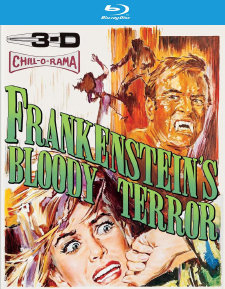
The Blu-ray 3D release of Frankenstein’s Bloody Terror is #35 in the Kino Cult line of titles. It sits in a standard blue Amaray case with a single pair of sealed anaglyphic 3D glasses and dual-sided artwork, featuring the Belgian theatrical poster artwork with the English language title on the front (as well as the slipcover) and the U.S. theatrical poster artwork on the reverse. The following extras are included on the disc:
- Audio Commentary by Tim Lucas
- Audio Commentary by Troy Howarth, Troy Guinn, and Rodney Barnett
- About the 3-D Restoration (HD – 25:28)
- Alternate Opening Titles (Upscaled SD – 2:15)
- Deleted Scenes (SD – 9 in all – 15:41)
- Theatrical Trailers (HD – 2 in all – 3:04)
- Radio Spots (HD – 3 in all – 1:42)
The first commentary features author and film critic Tim Lucas who openly loves all versions of this film, letting us know that right away before exploring the finer aspects of it. He dives into its production history, the filmographies of its cast and crew, and the aftermath of its releases across the globe. As always, it’s an essential listen. The second commentary features film historian and author of Human Beasts: The Films of Paul Naschy, Troy Howarth, as well as Troy Guinn and Rodney Barnett of the NashyCast podcast. They’re far more critical of this particular version of the film, mostly in how it was re-cut. They also delve into Naschy and the other actors, as well as their filmographies, and make comparisons to other Hombre Lobo films and the original version of this film. It’s a little uneven in places since they occasionally talk over or interrupt each other, but their contributions are invaluable.
Tim Lucas then goes into vast detail about the history of the film’s lack of 3D projection in the U.S. in About the 3-D Restoration, but also sets up viewers for what they are about to watch. The Alternate Opening Titles are taken from the U.K. release of the film under the title Hell’s Creatures. The Deleted Scenes are made up of moments taken from the original version of the film that was edited out of Frankenstein’s Bloody Terror, including the original opening reel and several other smaller edits throughout to shorten the running time. Last are two U.S. theatrical trailers and three U.S. radio spots.
Besides the obvious, there are a few things missing from previous releases. The Media Blasters Shriek Show DVD release from 2005 features a hybrid cut of the film, which is primarily the U.K. export Hell’s Creatures version of the film, but with the prologue that opens the U.S. version. This release also includes an audio commentary by Sam Sherman, an interview with Paul Naschy, and an image gallery. Not to be overlooked is the 2014 Subkultur Entertainment Region 2 Blu-ray release that includes the German theatrical and re-release trailers and a stills gallery.
Above all, having Frankenstein’s Bloody Terror in 3D finally is reason enough to celebrate. There’s still an ultimate release of this film on Blu-ray, Blu-ray 3D, and 4K Ultra HD containing its many different versions in higher quality, but for now, this will more than suffice. Here’s hoping it can be rescued from eventual vinegar syndrome someday. Highly recommended.
- Tim Salmons
(You can follow Tim on social media at these links: Twitter, Facebook, BlueSky, and Letterboxd. And be sure to subscribe to his YouTube channel here.)