
Trancers (4K UHD Review)
Director
Charles BandRelease Date(s)
1984 (October 18, 2022)Studio(s)
Empire Pictures (Full Moon Features)- Film/Program Grade: B+
- Video Grade: D-
- Audio Grade: C+
- Extras Grade: B-

Review
All that glitters is not gold, and all that is part of the Full Moon catalogue didn’t necessarily have its origins there. Such is the case with Trancers, a film that Charles Band produced and directed back in 1984 under his Empire International Pictures label. But it eventually found a home at Full Moon after Empire collapsed, spawning a total of five different sequels (to date) starting with Trancers II: The Return of Jack Deth in 1991. Still, all of that was in the future when Band made Trancers, which is perfectly appropriate since the plot revolves around time travel. The basic storyline of a man sent back from the future in order to protect ancestors from assassination is an obvious nod to The Terminator, but Trancers is oh so much more than that. It’s the time travel plot from The Terminator mixed with the neo-noir trappings of Blade Runner, with a few of the zombies from Night of the Living Dead thrown in for good measure. And yet even that description is selling Trancers short, since it’s got an attitude all its own—and the lion’s share of the credit for that belongs to writers Danny Bilson and Paul DeMeo.
Bilson and DeMeo had an uncanny knack for being able to combine various genre elements into a whole that still managed to feel internally consistent, regardless of the disparate nature of the sources from which they borrowed those elements. The key was to find a tonal framework that held everything together. The year after Trancers, they wrote and directed the no less wonderful Zone Troopers for Band, which is an alien invasion story in a World War II setting. The key in that case was that they treated it not just like a science fiction tale set during WWII, but rather like one as it might have been imagined during WWII—they opted for a form of retro-futurism. For Trancers, they hit upon hardboiled detective fiction as their tonal framework, and no matter what kind of science fiction, fantasy, or even horror elements that they wove into their story, they never lost sight of that fact. That means the key to Trancers is their conception of the character of Jack Deth, which also means that the other key to Trancers is the man who brought him to life, Tim Thomerson.
Thomerson may have gotten his start as a stand-up comic, but he understood that roles like Deth needed to be played perfectly straight, and that’s exactly the tone that Bilson and DeMeo’s story needed. There are plenty of tongue-in-cheek elements in Trancers, but none of them came from Thomerson. If he had let his guard down for a moment, or ever gave the impression that he was winking at the audience, even a single time, the whole film would have fallen apart. In fact (and please hang onto your pitchforks for a moment here), Thomerson was arguably better at playing this sort of character than Harrison Ford was in Blade Runner. Yes, Trancers is no Blade Runner, but Thomerson perfectly embodied the gruff, no-nonsense cops and detectives from hardboiled crime fiction that became such an integral part of film noir. Sure, Deckard was supposed to be a reluctant killer, but he was also supposed to be one of the best killers in the business, and Ford’s equivocal performance always made it feel like Deckard was in over his head. In other words, he sometimes felt like a tonal mismatch with the story (especially with the voiceover in the original theatrical version). Not so with Thomerson in Trancers, who plays Deth without a hint of equivocation, and so he ended up carrying Bilson and DeMeo’s neo-noir story on his gloriously padded shoulders.
Trancers opens in the 23rd century, where Jack Deth has gone rogue while hunting Trancers, otherwise normal-looking people who have been secretly brainwashed by Deth’s old nemesis Martin Whistler (Michael Stefani) and can be transformed into murderous zombies at a moment’s notice. Whistler, meanwhile, has hit upon a plan to go back in time and kill the ancestors of the ruling council in Angel City. Deth is reluctantly roped into going back in time as well to track down Whistler and protect the council’s progenitors. The trick is that the only way to travel into the past is to have your consciousness injected through the space-time continuum directly into the body of one of your own ancestors, temporarily possessing it. So, Deth ends up not just in Los Angeles circa 1984, but also in the form of his profligate forerunner Phil Dethton. Phil had just hooked up with Lena (Helen Hunt), providing Deth with an equally reluctant helper in his mission to protect ancestors like the drunken former baseball player Hap Ashby (Biff Manard). But will they be able to get to Whistler’s potential victims in time (no pun intended)? Trancers also stars Art LaFleur, Richard Herd, Anne Seymour, Telma Hopkins, and Alyson Croft.
Okay, sure. So, instead of an emo warrior from the future, you’ve got a hardboiled cop from the future. Instead of a Voight-Kampff test, you’ve got a Trancer Suspect Examination. Instead of Replicants, you’ve got mind-controlled zombies. That which we call a rose, by any other name would smell as sweet. No matter how you slice it, you’ve still got the time travel plot from The Terminator grafted into the retro-futuristic setting of Blade Runner. Yet the remarkable thing about Trancers is that it doesn’t feel like The Terminator, or Blade Runner, or even Night of the Living Dead. Instead, it feels like Trancers, through and through. That’s a testament to the way that Bilson and DeMeo were able to tie together all of their borrowed influences into something that seemed entirely their own. And that’s not even the end of their influences, either. They also threw in a James Bond element in the form of Ruthie Raines (Hopkins), who serves as the Q of the Trancers universe by supplying Jack Deth with the gadgets that he needs in order to survive his time-traveling misadventures. And yet, somehow, she feels at home in Angel City, too. Regardless of any flights of fancy, Trancers always feels internally consistent.
Trancers didn’t exactly light up the box office in 1984, but to be fair, it was never intended to. Empire International Pictures was a theatrical production and distribution company, but the titles that Band released through it always had the home video market as their end goal. But he still realized that he had a good thing going with Trancers. The following year, not only did he let Bilson and DeMeo write and direct Zone Troopers, but he also reunited Thomerson, LaFleur, and Manard for it. And when Empire fell apart a few years after that and Full Moon Entertainment rose out of its ashes, he reunited the same actors once again to launch a new direct-to-video franchise with Trancers II. Unfortunately, Bilson and DeMeo had already moved on at that point to write Disney’s big budget retro-futuristic comic book adaptation The Rocketeer, and the world of Trancers would never be the same without them.
Because always remember: dry hair’s for squids.
Cinematographer Mac Ahlberg shot Trancers on 35mm film using spherical lenses, framed at 1.85:1 for its theatrical release, but it’s been opened up slightly to 1.78:1 here—and that fact alone should raise warning flags that Band is selling a bill of goods when it comes to this “new” 4K master. Supposedly, it was going to be based on a 4K scan from the original camera negative, but like many of Band’s pre-Full Moon films, the source element appears to have been a print, and worse, this is the exact same master that was used for the previous Blu-ray versions. Is it even a remaster in any sense of the term? No. Hell, no. It’s just a plain old upscale from the 1080p master, which was already a mess to begin with. While the color reproduction and contrast range are both serviceable, everything has a harsh digital sheen to it, with so much sharpening applied that whatever film grain may have existed on the source element has been transformed into a sea of pure noise. As a result, it already looked like upscaled standard definition (even if it really wasn’t), and upscaling that into 4K has not done Trancers any favors.
Quite the opposite, in point of fact. Trancers actually looks worse in this upscaled 4K version than the Blu-ray does when upscaled to 4K at the viewer’s end—and that’s no mean feat, because upscales at the uncompressed source end nearly always look superior to upscaling from the compressed 1080p Blu-ray. But every rule has to have an exception, and Band now has the dubious honor of finding it. It’s possible that further sharpening has been applied in order to try to put lipstick on a pig, and that’s what makes things look worse, but it may simply be a disastrously bad upscale. Oh, and regarding the new Dolby Vision and HDR10 grades: as Noah once said to the Lord, riiiiiight. There’s no such thing. It’s just SDR in an HDR container, maybe with the existing saturation levels dialed up in a few notches (the reds can be a little more intense), but nothing outside the range of SDR, and honestly, I didn’t spend that much time comparing back and forth between the two. It wasn’t worth it. This is one of the single worst-looking 4K releases that I’ve ever seen—even ones that were in the wrong color space looked better than this.
Audio is offered in English 5.1 and 2.0 mono Dolby Digital, with optional English SDH subtitles. Yes, Virigina, Band did indeed stick with lossy Dolby Digital, even on 4K. Trancers was released theatrically in mono, and this 5.1 track just feeds an attenuated version of the mono signal into all five channels—it’s not a real 5.1 remix in any sense of the term, just 5-channel mono. Otherwise, they’re not too different from each other, and they’re serviceable at best.
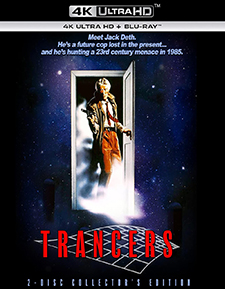
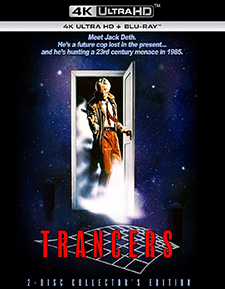
Full Moon’s 4K Ultra HD Collector’s Edition release of Trancers is a two-disc set that includes a Blu-ray with a 1080p copy of the film and a slipcover that duplicates the theatrical poster artwork on the insert. The following extras are included on both discs (so for whatever it’s worth, the Blu-ray isn’t just a repressing of the old one):
- Commentary with Tim Thomerson and Charles Band
- Trancers: City of Lost Angels (Upscaled SD – 24:41)
- Gone Down the Line (HD – 19:50)
- Trancers: Official Trailer (HD – 2:59)
- Cybercrime: The Making of Trancers (HD – 14:27)
- Archival Interviews (Upscaled SD – 2:01)
- Still Gallery (HD – 1:39)
Full Moon added one new extra for this release: Gone Down the Line, a video essay by Chris O’Neill. Narrated by Claire Foy, it’s really more of a love letter to Trancers, and there’s nothing wrong with that, but it does examine the film’s inspirations and how it fits into Charles Band’s oeuvre as a whole. It also spends some justifiable time on the wonderful cast.
The rest of the extras are archival, most of them from Full Moon’s original Blu-ray release of Trancers in 2014. Cybercrime: The Making of Trancers is an amiable documentary by Ballyhoo Motion Pictures featuring interviews with Band, Thomerson, Danny Bilson, and Paul DeMeo. The writers explain how they took Band’s original idea of a cop from the future and tossed out nearly everything else in favor of their own story. They’re the ones responsible for the hard-boiled detective stuff, including the line that was lifted directly from Robert Montgomery’s Lady in the Lake. Cybercrime also explores the casting process and the theatrical release, including various test screenings under different titles.
Trancers: City of Lost Angels is a short that was originally intended to be a segment of the 1988 anthology Pulse Pounders, but that film fell apart along with Empire International Pictures. Thomerson, Helen Hunt, Art LeFleur, Telma Hopkins, and Alyson Croft all reprised their roles, joined this time by Grace Zabriskie. It’s another time-traveling adventure, with Jack Deth having to balance his pursuit of Edlin Shock (Velvet Rhodes) with his increasingly rocky relationship with Lena.
Finally, there’s a commentary by Band and Thomerson. They may not quite be John Carpenter and Kurt Russell, but the two of them still play off each other well and do a good job of refreshing each other’s memories (even if Thomerson thought that they were going to edit his bad language out later, which they definitely didn’t). There’s also a set of vintage interviews with Thomerson, Hunt, and Megan Ward, and as the presence of the latter should indicate, they were conducted in 1991 to promote the release of Trancers II: The Return of Jack Deth. (There’s also a brief addendum at the end with Thomerson in 2013.)
So, as should be evident from the film review, I adore Trancers. As should be equally clear from everything else in the review, I don’t recommend this 4K release. Skip it. Don’t make the mistake of encouraging Charles Band by giving him your money. The old Blu-ray looks (if not sounds) better than this 4K version, and while you’re losing out on the Chris O’Neill video essay that way, it’s not worth spending twice the money for downgraded video. Better yet, Umbrella Entertainment’s new Full Moon Fright Box Vol. 3 offers the same 1080p master at a better bitrate, and with lossless DTS-HD Master Audio to boot. It also adds new extras of its own, and better yet, it comes with Puppet Master II, Puppet Master III, and the delight that it is Slave Girls from Beyond Infinity. If you love the original Trancers as much as I do, that’s currently your best option. It’s not cheap, but it’s worth every penny. But if you must go direct to Full Moon, then stick with the old Blu-ray and save your extra pennies for something else.
- Stephen Bjork
(You can follow Stephen on social media at these links: Twitter, Facebook, BlueSky, and Letterboxd).