
Salem's Lot (4K UHD Review)
Director
Tobe HooperRelease Date(s)
1979 (March 31, 2026)Studio(s)
Warner Bros. Television (Arrow Video)- Film/Program Grade: A-
- Video Grade: A
- Audio Grade: A-
- Extras Grade: A


Review
For many horror aficionados, Tobe Hooper’s miniseries version of Salem’s Lot, based upon the novel of the same name by Stephen King, is one of the finest and most effective made-for-TV horror movies ever produced. It first hit the air waves in November of 1979 on CBS and was later cut down and released theatrically in non-US territories. Almost four decades since it originally premiered, it continues to garner much attention from fans, especially after Tobe Hooper’s untimely passing in 2017.
Author Ben Mears (David Soul) has returned to his hometown of Salem’s Lot in Maine, intending to write a novel about the unoccupied Marsten house, which is purported to be haunted. Much to his surprise, it has recently been acquired by Richard Straker (James Mason) and his business partner Kurt Barlow (Reggie Nalder), though Barlow keeps a very low profile. The two intend to open an antique shop in town, but Mears suspects that something sinister is happening inside the house, having feared it since his childhood. Meanwhile, Mears begins courting a local woman, Susan Norton (Bonnie Bedelia) and befriends her father, the town doctor Bill (Ed Flanders). The troubles begin when a young boy goes missing, who’s a friend of Mark’s (Lance Kerwin), a horror film and comic book fan who quickly, along with Mears, realizes what’s going on. Amid the varied personal lives of the residents of Salem’s Lot, they’re all slowly being turned into vampires by Straker and Barlow. The rest of the cast includes Lew Ayres, Fred Willard, Julie Cobb, Kenneth McMillan, Geoffrey Lewis, Barney McFadden, Marie Windsor, Bonnie Bartlett, George Dzundza, Elisha Cook Jr., and James Gallery.
The story of Salem’s Lot differentiates from the original novel mostly by jettisoning or combining characters and altering or dropping certain scenes altogether, relying more on visuals and atmosphere than outright scares. Certain characters in the miniseries have no real bearing on the overall plot. They participate more as part of a metaphor for small towns with big secrets and unsavory people, ultimately staying in the background, but with an inescapable fate. The Dracula-esque Kurt Barlow has been transformed from a more sophisticated erudite character prone to long speeches into a wordless Nosferatu monster, and a frightening one at that. Ben Mears is set up fairly well, and David Soul gives a decent, albeit underrated performance, especially when he’s confronted with the supernatural. His horrified and panicked reactions to the vampires seem more genuine than a Van Helsing heroic type. The film is also fondly remembered for specific moments, including scenes of vampiric young children floating and scratching outside of windows and asking to be let in, not to mention Barlow’s memorable and startling first appearance.
Despite many of its now dated qualities, the original Salem’s Lot miniseries fares much better than every adaptation of it since. Both the 2004 and 2024 attempts leave much to be desired, even though they did try and be more faithful to the source novel in other ways. Salem’s Lot might have been made for 1979 TV viewers, but it’s effective, and it left an indelible mark upon those who saw it... especially on those who were probably a little too young to be watching.
When Salem’s Lot initially aired, it was presented in two 2-hour parts and later shown again as a 3-hour version, severing the credits in the middle. It was also released to theaters internationally in a truncated 2-hour form. This version was originally released on VHS and was the only way to see the film for many years. Warner Bros. did eventually release the 3-hour version on LaserDisc, DVD, and Blu-ray, but until now, the full original miniseries has never been available commercially.
As for the theatrical version of the film, it feels much clunkier, especially in regards to the intended commercial breaks. Many scenes are highly truncated, though the latter half of the film is more straightforward since most of the major cuts occurred in the first part. After all, the second part of the miniseries is where the real meat of the vampire action occurs. One notable loss that feels more like a gain than a loss is the excision of the prologue, where we see what’s happened to Ben and Mark two years after the film’s main events. Personally, I’ve never really been much of a fan of this way of telling a story since it, more or less, spoils it. Even if it does have some positive aspects, the ends do not justify the means and the theatrical version is the lesser version, and it’s not even close. However, for many, this is the way they first experienced Salem’s Lot, and who am I to tell them otherwise?
Cinematographer Jules Brenner shot Salem’s Lot on 35mm film with (from what I can gather) Panavision Panaflex cameras and spherical lenses. The results were finished photochemically and presented on television in the aspect ratio of 1.33:1 and theatrically in 1.85:1. Arrow Video debuts both versions of the film on separate Ultra HD discs, sourced from new 4K 16-Bit restorations of the original camera negative and a 35mm interpositive respectively, and featuring an aspect ratio of 1.37:1. Both restorations have been graded for High Dynamic Range in HDR10 and Dolby Vision, authored by David Mackenzie of Fidelity in Motion, and encoded to two triple-layered BD-100 discs.
The original miniseries is sourced primarily from the original camera negative outside of optical transitions, and it’s far and away the finest it has, and likely will ever, look on home video. FiM authoring duties allow for a steady and solid level of medium grain with high levels of fine detail, and a bitrate that primarily sits in the 80 to 100Mbps range. According to the accompanying booklet, archival video masters and an off-air recording were used for reference purposes, likely for presentation, framing, and color. The HDR grades soak up every last bit of detail in the palette with some very nice greens, blues, and occasional reds. Flesh tones are also very attractive. Though the film was shot for television, there’s a variety of camera movement, blocking, and hues to contend with, and they’re represented dutifully here with deep blacks and perfect contrast. Outside of the aforementioned opticals, which I personally prefer instead of re-creating transitions digitally, there’s not a flaw in sight. The image is stable, clean, and absolutely gorgeous.
The theatrical version, sourced for the previously mentioned interpositive, is a strong presentation in its own right. Though a generation away from the original camera negative, it’s still quite potent with the same level of care given to the miniseries version. Grain is a little heavier, but well-attenuated. The contrast range isn’t nearly as broad, but regardless there are deep blacks and shadows, as well as the same beautiful color palette. Bitrates also sit mostly between 80 and 100Mbps, modulating only in areas where less detail is on the screen. It’s stable and clean aside from very occasional speckling, which you would need to be paying close enough attention to even notice. One thing worth mentioning is that, unlike the VHS presentation, it no longer opens with the title Salem’s Lot: The Movie, only Salem’s Lot.
Audio for the miniseries version is included in English 1.0 DTS-HD Master Audio, while the theatrical version features audio in English 1.0 LPCM. Optional subtitles are available for both versions in English SDH. This was a made-for-television production, after all, so the soundtrack is going to be fairly evenly-produced. Both tracks exhibit a lot of the same qualities, which is a narrow sound space with some much-appreciated mid-range. Dialogue and sound effects are rendered well enough, and Harry Sukman’s memorable score is given plenty of weight within the single channel confines. Both tracks are clean and free of any obvious issues.
Disc one contains three ways to watch the film (via seamless branching), as well as a fourth, alternate option (more on that later); while disc two contains the theatrical option only. Running times are as follows:
- Miniseries Part 1 (95:51)
- Miniseries Part 2 (96:01)
- Extended Movie (183:25)
- Theatrical Version (110:11)
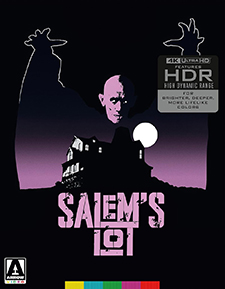
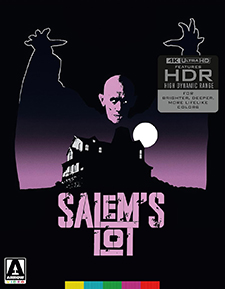
Arrow Video’s 2-Disc 4K Ultra HD release of Salem’s Lot sits in a black Amaray case with a “Salem’s Lot, POP. 2013, EL. 289” town sign sticker and a double-sided insert featuring promotional poster artwork for the film traditionally used for its home video artwork in purple (it was blue on the VHS), and the Italian theatrical poster artwork on the reverse with English text. Alongside it is a double-sided poster with the same artwork options (but with Italian text on the Italian poster artwork); and a 100-page booklet containing cast and crew information, the essays The Monster Kid Was Right by Sean Abley, Returning to Salem’s Lot by Sorcha Ni Fhlainn, A Pandemic of Evil by Richard Kadrey, Salem’s Lot Memories: An Interview With Tobe Hooper by Chris Alexander, I Was a Teenage Vampire Hunter: An Interview With Lance Kerwin by Michael Gingold, She Said “Boom”: An Interview With Julie Cobb by Lee Gambin, presentation information, production credits, and special thanks. Everything is housed in a rigid slipcase with a slipcover, both featuring the aforementioned promotional artwork. The following extras are included on each disc:
DISC ONE (ORIGINAL TV MINISERIES)
- Commentaries:
- Tobe Hooper
- Bill Ackerman and Amanda Reyes
- Alternate TV Footage:
- Commercial Bumpers (UHD – 2 in all – :16)
- Antlers Death (Original Broadcast Version) (UHD – :21)
- Shooting Script Gallery (HD – 196 in all)
- Easter Egg (UHD – 95:58)
DISC TWO (THEATRICAL VERSION)
- Audio Commentary by Chris Alexander
- King of the Vampires (HD – 21:09)
- Second Coming (HD – 26:00)
- New England Nosferatu (HD – 13:08)
- Fear Lives Here: Revisiting the Locations of Salem’s Lot (HD – 6:56)
- Salem’s Lot: We Can All Be Heroes (HD – 9:19)
- Salem’s Lot: A Gold Standard for Small Screen Screams (HD – 19:50)
- Trailers:
- Salem’s Lot (1979) (HD – 3:23)
- A Return to Salem’s Lot (HD – :44)
- Salem’s Lot (2024) (HD – 2:30)
- Image Gallery (HD – 89 in all)
Both audio commentaries on disc one can only be heard when watching the extended movie version of the miniseries. The 2016 commentary by the late Tobe Hooper has always been a welcome addition since the Warner Bros. Blu-ray debut of the film. It’s a scene-specific track that’s been filled in here and there to cover up silences, though many of those remain. Nevertheless, it’s important to have him on record to talk about the film. He provides lot of details about his work for the film and how it all came together, occasionally commenting upon specific moments as they happen. New to this release is a commentary by podcaster Bill Ackerman and author Amanda Reyes, who start off by paying tribute to the late, great Lee Gambin. It’s a very well curated track as the two delve into the period in which the film was made, while also examining the television landscape and what the film was airing up against, the careers of the main players, the history of the project, and the thematics involved with the story.
Next is a set of Alternate TV Footage, which consists of two Commercial Bumpers for the film that aired before and after commercial breaks, and the original broadcast version of Bill Norton’s death scene. Also included is the original Shooting Script Gallery, which does offer some differences from the final film, though one of the pages is missing. One of the largest differences is that Barlow actually speaks a couple of times, but it was decided not to use his dialogue.
One last very important item is an Easter Egg. Pressing left on your remote control while Miniseries Part 2 is selected will allow you to watch the second part with the less gory antlers death of Bill Norton, as it originally aired. It’s a nice little surprise, though odd that Arrow chose to hide the option from plain view. Both the miniseries and theatrical cuts as presented on this release include the full versions of the scenes in which Cully makes Crockett put the end of the shotgun barrel in his mouth, and the full bloody death of Bill Norton by Straker.
Author, filmmaker, musician, and all-around fan of Salem’s Lot, Chris Alexander, provides a wonderful audio commentary for the theatrical version, which is more of an extemporaneous chat about his love for the film. However, unlike most of these sorts of tracks, he’s very well-educated about the film and horror in general, leaving very few moments of silence and providing his own particular slant about the film, while also discussing aspects surrounding it. He also takes time to point out the passing of Lee Gambin who was an enormous fan of Salem’s Lot, and it’s a shame that we never got to hear his own uninterrupted impromptu thoughts about the film.
King of the Vampires features an interview with Stephen King biographer Douglas E. Winter who introduces himself and delves into his personal association with Stephen King, how King’s material influenced the rest of the genre, King putting himself and his craft into his work, vampire lore and small town sociopolitical underbellies, the success of Stephen King’s books and their adaptations, the history of developing and producing Salem’s Lot, made-for-television horror in the 1970s, differences in Salem’s Lot from the original novel, the impact on viewers, and the importance of honoring a novel when adapting it. In Second Coming, Paperbacks from Hell author and critic Grady Hendrix discusses horror literature becoming chic in the 1970s, the birth of the idea for Salem’s Lot, what occurs beneath the surface of small towns, King’s anger in his early novels, the publishing and success of King’s novels, the appeal of Salem’s Lot, varying qualities of King’s work to readers, and how unique he is as an author.
In New England Nosferatu, author and filmmaker Mick Garris talks about the nature of Stephen King’s work, Tobe Hooper’s knowledge of horror and his involvement with Salem’s Lot after the success of The Texas Chain Saw Massacre, initially being disappointed with Salem’s Lot coming to television, King’s attitude about adaptations, and the lasting quality of the film. Fear Lives Here sees Elijah Drenner on location in Ferndale, California visiting the filming locations and, shockingly, how very little has changed. We Can All Be Heroes features Heather Wixson, author of Monsters, Make-Up & Effects and co-author of In Search of Darkness, recalling the story of Salem’s Lot, analyzing it and making connections to real life. A Gold Standard for Small Screen Screams features podcasters Joe Lipsett and Trace Thurman of Horror Queers who cover much of what’s already been said before, but they do delve a little more into the minutiae of outsider/insider aspects of the story and the queer overtones of some of the characters.
Next are three trailers: one for the international theatrical release of the film, one for A Return to Salem’s Lot, and the last for the 2024 iteration. Last is an Image Gallery containing 89 images of promotional photos, behind-the-scenes stills, lobby cards, home video artwork, and posters.
Needless to say, Arrow Video knocked this one out of the park. Salem’s Lot is a favorite among many horror fans young and old, and this release finally does it some much-needed justice on home video. If you’re a fan, run, don’t walk, and procure a copy for your shelf. Highly recommended.
- Tim Salmons
(You can follow Tim on social media at these links: Twitter, Facebook, BlueSky, and Letterboxd. And be sure to subscribe to his YouTube channel here.)