
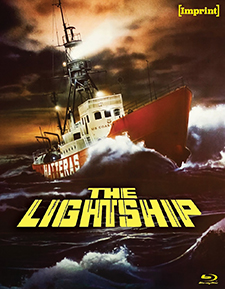
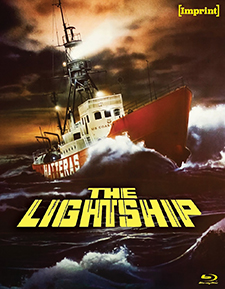
Lightship, The (Blu-ray Review)
Director
Jerzy SkolimowskiRelease Date(s)
1985 (November 26, 2025)Studio(s)
CBS Theatrical Films (Imprint Films/Via Vision Entertainment)- Film/Program Grade: D+
- Video Grade: A-
- Audio Grade: A
- Extras Grade: B-

Review
[Editor’s Note: This is a Region-Free Australian Blu-ray import.]
The late Robert Duvall and the fine German actor Klaus Maria Brandauer did a movie together? Directed by Jerzy Skolimowski, who made the excellent Moonlighting (1982) with Jeremy Irons? The Lightship (1985)? Ever heard of it? Neither had I, and it turns out with good reason.
Well, actually two reasons. The lesser reason is because it was produced by the American television network CBS’s short-lived theatrical feature film division (though the crew was mostly West German), their second attempt following Cinema Center Films in the late-’60s/early ’70s. None of the 11 features they released between 1981-85 made any money, despite the company’s use of important directors and some reasonably big-name stars. The Lightship, reportedly, was the last one produced, though not the last released. Because their theatrical runs passed through a variety of distributors, CBS-made movies like this have seen only spotty release on home video.
However, the main reason you’ve probably never heard of The Lightship is because it stinks. A remake of a reportedly much-superior West German film released in 1963 (despite its origins, it starred British character actor James Robertson Justice), which itself was based on a novel by Siegfried Lenz. Regardless, it features what may be Robert Duvall’s worst-ever film performance and, indeed, except for a decent work of a couple of the other actors, everything about it is badly-done when not outright terrible.
It’s 1955 and near Norfolk, Virginia, German-born Captain Miller (Brandauer), getting his son, Alex (Michael Lyndon, actually Michal Skolimowski, the director’s son), out of some kind of jam with the local police, takes him aboard his lightship, a permanently anchored Coast Guard vessel serving as a floating lighthouse. There’s some kind of father-son acrimony going on, but before the audience learns much of anything about that, three criminals on the lam take over the ship: flamboyantly gay ringleader Caspary (Duvall), dumb goon Eugene (William Forsythe), and trigger-happy psychotic Eddie (Arliss Howard).
The small crew of six, including black cook Nate (Badja Djola), tough former boxer Stump (Robert Costanzo) and others want to seize control back, but cool-as-a-cucumber Capt. Miller bides his time, though Alex believes his father is simply cowardly.
Variety reported that Duvall and Brandauer switched parts just before shooting began, offering no clues how that came about. Brandauer had recently played an eccentric villain in the James Bond movie Never Say Never Again and maybe was averse to playing a similar part, or perhaps Duvall was itching to play such an oddball bad guy. Or maybe Jerzy Skolimowski thought of the idea, or maybe the studio insisted upon the change. Whatever, Brandauer delivers a subtle, interesting performance, while Duvall is off-the-charts awful. The only comparable performance remotely like it that I can think of is Malcolm McDowell’s kooky Nazi officer in The Passage (1979).
In The Lightship, Robert Duvall is like a cross between director John Waters and Rupert Pupkin, Robert De Niro’s character in Martin Scorsese’s The King of Comedy. He sports a Waters-like pencil mustache, wears a white hat of the type Truman Capote fancied, gold-rimmed tinted glasses, a bowtie, pink shirt, vanilla vest, and carries a walking stick. Further, Duvall affects a halting, velvet-tongued delivery with a strange, indiscernible accent, kind of a roadshow Hannibal Lecter. He is utterly ludicrous.
Meanwhile, as Captain Miller’s son, Michal Skolimowski does no acting at all. Appearing uncomfortably constipated throughout, his facial expressions are basically inert, even during moments of supposed great stress and emotion.
Besides Brandauer, Badja Djola and Robert Costanzo are decent enough as put-upon sailors, and Arliss Howard, later Joker’s friend Cowboy in Stanley Kubrick’s Full Metal Jacket, is excellent, but down the line every character is one-dimensional. William Forsythe’s character, for instance, is a physically powerful simpleton capable of unpredictable bursts of violence, the kind of Lennie-like part Lon Chaney Jr. played in crime films when his career was on the downslide.
With CBS’s film division collapsing around them, once shot the film was made even worse by what might have been postproduction budget cuts and tinkering. The Hans Zimmer-produced synthesized musical score by Stanley Myers is terrible, with underscoring of scenes in all the wrong places, and which gives the film the air of a cheap Charles Bronson thriller during his Cannon Films days.
Postproduction tinkering included the last-minute addition of pointless, barely-literate narration by Alex’s character, material that makes the infamous Harrison Ford narration stuck onto Blade Runner seem like Shakespeare by comparison. To wit: “A dead man is an amazing thing. It must make some kind of photograph in your heart. Sometimes it just stays there, whether you want it to or not.”
Even Jerzy Skolimowski’s direction is poor. The actors seem totally on their own, given how variable their performances are, and he should’ve put the kibosh on Duvall’s indulgent, ludicrous characterization. Worse, there’s no sense of spatial relationships at all. Filmed aboard a real ship, every interior is too cramped to get any sense of space, and there’s no sense of where the characters are in relationship to one another, or what part of the ship scenes are taking place.
Did I mention that I didn’t care much for the film?
Imprint’s Region-Free Blu-ray presents the film in a “1080p high-definition transfer” (no other information provided) that’s okay, not great, the film presented in 1.78:1 widescreen, approximating its 1.85:1 theatrical version. The transfer looks a little dull here and there, but some of that be inherent in the original camerawork and shooting conditions with 95% of filming on the water. Better is the audio, offered in both DTS-HD Master Audio (5.1) and LPCM (2.0 stereo), though that synthesizer score gives listeners little reason to rejoice. Optional English subtitles are provided.
The lone extra feature is a new audio commentary track by historian Michael Brooke.
The 1963 version of The Lightship actually sounds pretty good and I’d be eager to see this same basic material done better. As for this Lightship, it’s kind of fascinating in its awfulness, but it’s an easy pass to all but the Robert Duvall completists out there.
- Stuart Galbraith IV