
Death Ship (Blu-ray Review)
Director
Alvin RakoffRelease Date(s)
1980 (April 14, 2026)Studio(s)
Astral Bellevue Pathé/Bloodstar Productions/Lamitas/CFDC (Kino Lorber Studio Classics)- Film/Program Grade: C
- Video Grade: B
- Audio Grade: A-
- Extras Grade: A

Review
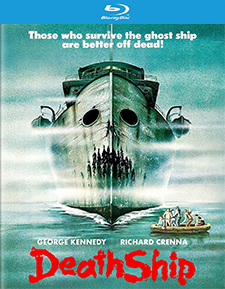
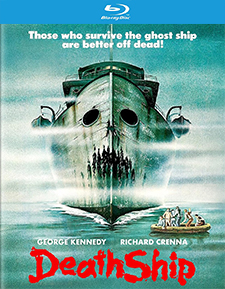
Horror at sea is the basis of such films as Ghost Ship, Triangle, Deep Rising, and The Last Voyage of the Demeter. With no way to escape, a claustrophobic environment combines with imminent danger to terrorize those on board. In 1980’s Death Ship, an old, run-down freighter appears to have a murderous mind of its own.
Captain Ashland (George Kennedy), a no-nonsense, by-the-rules cruise ship commander, will be relieved of command in mere days of a job he has little respect for. The crew doesn’t much care for Ashland, whom they regard as cold-hearted and tyrannical.
As the voyage comes to a close, the liner is drawn into the path of another ship. Despite desperate efforts to change course, the liner is rammed by what appears to be a derelict ship causing the engine room to flood. The handful of people who survive manage to stay afloat on a makeshift raft. Among them are first mate Trevor Marshall (Richard Crenna), his wife (Sally Ann Howes) and two kids, the captain, a widow (Kate Reid), lovers Nick and Lori (Nick Mancuso, Victoria Burgoyne), and band leader Jackie (Saul Rubinek). The small group manages to climb aboard the rusting freighter only to find that there’s no crew, yet we see intermittent shots of the engine starting apparently by itself and chugging away.
As one of the survivors points out, “This whole ship seems to have a life of its own.” Doors and windows open and close by themselves, lights flicker, a record player starts up spontaneously, and the ship’s wheel turns by itself. It soon becomes clear that the ship is evil, intent on killing its innocent passengers. The narrow corridors, abandoned decks, and tight spaces contribute to a sense of eeriness and quick cuts to ghostly images and sounds foreshadow doom. The bulk of the film relies on typical horror movie tropes—children left alone, increasingly weird expressions on the captain’s face, a romantic interlude amid danger, and questionable behavior that imperils the characters.
The acting overall is mediocre. Kennedy’s performance consists of looking annoyed to be captain of a cruise ship and looking possessed by some evil force when he’s aboard the creepy freighter. Kare Reid is wasted in a thankless role as the widow. Mancuso and Burgoyne are stereotypes of lovers who can’t keep their hands off each other even when their lives are in danger. Rubinek is an odd choice for the band leader. If the role was intended to provide comic relief, he fails miserably. Crenna and Howes are adequate as the heads of their small family, with Crenna the nominal hero taking charge when things get bad but turning out to be ineffectual in the face of forces he doesn’t understand. As the mother, Howes doesn’t seem especially concerned about letting her young kids run wild on an old ship that could prove dangerous even if otherworldly forces weren’t at play.
Director Alvin Rakoff does his best with a second-rate script and limited resources. Many of the gruesome horror bits are backloaded, so that the sense of unnerving supernatural elements at play escalates. In the third act, the true horror emerges, but it might be too late. The slow pace kills momentum, so that instead of increasing tension, it bogs down in too much unnecessary dialogue as characters try to figure out what we already know.
Death Ship was shot by director of photography Rene Verzier on 35mm film with Panavision Panaflex cameras and spherical lenses, and presented in the aspect ratio of 1.85:1. The Blu-ray from Kino Lorber Studio Classics features a brand new HD master sourced from a 4K scan of the original camera negative, with the option of watching the theatrical and extended cuts, the difference being an additional three-minute seen between Trevor and the captain that was re-incorporated into the TV cut of the film. The difference in quality between the new footage and stock material is apparent in the color variations as the stock footage has a slightly yellow cast to it. The cinematography enhances a sense of eeriness by giving the inanimate, derelict freighter a sense of foreboding with its ghostly presence. The final third of the film is all-out horror with gruesome images dominating and geared to shock. The only scenes on the cruise ship are the wheelhouse and the ballroom. There are no other shots to establish the size and splendor of the liner. Clever use is made of equipment on the freighter that it turns on its victims.
The soundtrack is English 2.0 mono DTS-HD Master Audio. English SDH subtitles are an option. Dialogue is clear throughout. The ramming of the two ships is accomplished through shaky camera, actors thrust across the ballroom, and deft editing with loud sounds of a collision completing the illusion. Sounds of rusted doors, an onboard crane, a massive anchor being raised and lowered, and a boarding ladder breaking away from the freighter add to the atmosphere of dread. Periodic ghostly announcements in German from the freighter’s speaker system add a weird element of disconcerting confusion. Ivor Slaney’s score contributes significantly to the film’s escalating terror with its creepy chords and ominous tones.
Bonus materials on the Blu-ray release from Kino Lorber Studio Classics include the following:
- Audio Commentary for the Theatrical Cut by Paul Corupe and Jason Pichonsky
- Audio Commentary for the Theatrical Cut by Alexandra Heller-Nicholas and Josh Nelson
- Audio Commentary for the Extended Cut by Alvin Rakoff, Moderated by Jonathan Rigby
- Audio Commentary for the Extended Cut by Alexandra Heller-Nicholas and Josh Nelson
- Isolated Score for the Extended Cut by Composer Ivor Slaney
- Stormy Seas: The Voyage From Bloodstar to Death Ship (Upscaled SD – 41:16)
- What the Ship Is Saying (HD – 3:47)
- Bloodstar: Short Story Script by Jack Hill (Upscaled SD – 3:44)
- Theatrical Trailer #1 (SD – :58)
- Theatrical Trailer #2 (Upscaled SD – 1:35)
- Trailers:
- Deepstar Six Trailer (SD – 1:57)
- Leviathan Trailer (HD – 1:54)
- Below Trailer (SD – 2:27)
- Deep Rising Trailer (SD – 1:25)
- Juggernaut Trailer (SD – 2:54)
Commentary #1 – Paul Corupe of Cannuxploitation.com and film historian Jason Pichonsky are both enthusiastic about Death Ship, saying that it’s a “fun film to watch.” They note the title credits font is similar to that often used by the Nazi regime. Death Ship was a tax shelter movie made when Canadian film production saw a boom from the 1970s into the 1980s. Mostly low-budget and unexceptional, these films were subject to criticism because they didn’t reflect Canadian sensibilities or culture. The films provided employment to Canadians but often brought in American actors “past their time.” The ballroom scene was filmed at a Canadian hotel with the camera swaying slightly to suggest motion of a ship at sea. Tax incentives gave the Canadian film industry a “kick in the pants.” Critics at the time savaged Death Ship. The commentators discuss a “patchwork scene” composed of footage from different locations and stock footage. The original script was written by Jack Hill, who got his start working for Roger Corman and was known for salvaging films or creating them using added footage from foreign films.
Commentaries #2 and #4 – Film historians Alexandra Heller-Nicholas and Josh Nelson refer to Death Ship as a film about the ghost of fascism with “good old-fashioned, crazy horror.” They point out logical inconsistencies and describe it as “a troubled production” because not everything went as planned. It’s an atmospheric film with the final half hour especially good. Discussing directors, they note that many films were made by the wrong people for the wrong reasons. Canadian horror is part of the country’s national film history and was prolific in the 1970s and 1980s. Horror was a viable genre for film production. Death Ship is unusual because it aligns more with disaster movies than horror in its first hour. In the 1970s, Nazi films were popular, exemplified by Marathon Man, The Boys From Brazil, Force 10 From Navarone, and The Eagle Has Landed. Nostalgia and fascism had a close relationship at the time.
Commentary #3 – Director Alvin Rakoff, moderated by film historian Jonathan Rigby, says that if you sit back and wait for the film you want to do, you won’t work very much. In retrospect, there was a number of films he shouldn’t have made. He’s both surprised and pleased that Death Ship has developed a cult reputation. He believes you can come back to a film and change your opinion about it. Rakoff first saw an inferior script pepped up by Los Angeles writers. He was initially rude and condescending toward the film, regarding it as not a major project in his career. He’s always been sensitive to scripts and worked for Hammer Films a number of times. Jack Hill, “exploitation royalty,” came up with the idea for Death Ship. He wanted the ship to be sentient as objects were in The Car and Steven Spielberg’s Duel. The production managed to get a condemned ship for filming near Biloxi, Mississippi. It was taken out for just one hour of filming but it conked out and had to be towed back to the harbor. Stock footage came from the 1960 shipwreck movie The Last Voyage. George Kennedy was associated with disaster films after appearing in the Airport movies and Earthquake. The genesis of Death Ship is a UK/Canada agreement from 1975 that aspired to boost the film industries in both countries and often starred American actors. Rakoff recalls that location filming in the Gulf of Mexico was very hot. He believes Death Ship boasts a very good cast for a low-budget film.
Isolated Score for the Extended Cut – This is the entire extended version of the Death Ship score with no dialogue or sound effects. Only the evocative music by composer Ivor Slaney is heard.
Stormy Seas: The Voyage From Bloodstar to Death Ship – This documentary refers to Death Ship as a Class B picture with the cast and crew doing the best they could “entertaining in an off-kilter way.” Director Alvin Rakoff says it’s not one of his major works—a minor film on the way to other things. As a producer for the BBC, Rakoff did a lot of live television and gave Sean Connery his first lead role in 1957. Writer Jack Hill claims the film “does have its moments.” Rakoff was amazed that the film has become a cult favorite. Bloodstar was the original title, and Hill speaks about how the script evolved. He hoped to direct, but Rakoff, with more experience, was eventually chosen. Often, the cast lifts a weak script. George Kennedy speaks highly of Richard Crenna who entertained the cast with stories and made them laugh. Crenna could make fun about anything. Kennedy offers anecdotes about the making of the film, noting that the smell of the derelict vessel was awful. The ship was due to be scrapped and because of its condition, safety people were on hand. In a scene shot in Mobile Bay, Nick Mancuso refused to get into oil-contaminated water. A form of disjointed editing, which had been used in commercials, was employed for specific scenes of Death Ship. The film made its money back. Jack Hill was disappointed when he saw the finished film in a theater, but Kennedy thinks, “It didn’t turn out to be that bad at all.”
What the Ship Is Saying – In an installment of Katarina’s Nightmare Theater, Katarina Severen plays a school teacher next to a blackboard. In professorial tones, she says that Death Ship is about a mysterious ghostly freighter that rams and sinks a modern cruise ship whose survivors climb aboard and discover its gruesome history. Clips from the film are shown.
Bloodstar: Short Story Script – Pages from various parts of Jack Hill’s original Bloodstar script, some with handwritten marginal notes, are shown in slideshow format.
There are some missing items from previous DVD and Blu-ray releases, including a couple of brief deleted scenes, a side-by-side comparison between the theatrical and TV versions of the bloody shower scene, several additional trailers (likely in multiple languages), and various still galleries.
Death Ship has some name actors and gruesome effects but never fully engages the viewer. It’s slow-paced, with uninspired acting and a made-for-TV look. The ultimate revelation is grim and shocking but by the time we get there, the film has squandered all suspense and credibility with inept scripting and weak characterizations. George Kennedy, directed by Alvin Rakoff to stare into space with dead eyes for most of the picture, eventually comes off looking like a zombie, while the freighter never quite conveys a personality of evil.
- Dennis Seuling